Exhibition: Pepper and the Creation of a Global Taste

Black pepper, grown in the monsoon-soaked hills of South India, served as a defining flavor of the Roman Empire for centuries. While certain historical narratives frame the spice trade as a disorderly exchange of luxury goods driven by the romance of exploration, this exhibition challenges conventional wisdom by presenting the Indo-Roman pepper trade as a sophisticated, intermodal, and industrial-scale machine. In other words, ancient globalization was not merely an abstract concept; rather, it was a lived system that connected complex credit systems, intermodal logistics, state bureaucracy, and mass consumption into a singular, seamless network across continents. By chronologically tracing the lifecycle of pepper from credit markets to dinner tables, this collection of objects suggests that the Roman Empire was as much defined by its complex supply chains as by its commanding legions.
The curation strategy of this exhibition goes beyond surface-level aesthetics to investigate the fundamental mechanics of ancient economies. In other words, to truly understand how a perishable spice became a household staple in a region four thousand miles away, one must examine the exact tools that propelled the Indo-Roman pepper trade. Thus, the exhibition is chronologically divided into four sections: (1) Financing and Risk, (2) Infrastructure, Logistics, and Movement, (3) Regulation, Scale, and Accessibility, and (4) Consumption. This structure of flow enables visitors to visualize the journey of pepper not just as a series of isolated events, but as an intricately planned handover between distinct intermodal systems. From legal contracts that ensured appropriate risk management to mission-oriented containerization, the curated objects reflect the synchronization of monsoon winds, merchant coalitions, and imperial trading standards.
To begin, the first section debunks the myth that ancient trade was conducted through simple barter. The wearisome distances of Indian Ocean trade required massive capital investment on a scale that forced Roman merchants to develop complex financial instruments. To illustrate the legal contracts that served as foundations for large-scale trade, the exhibition opens with the Muziris Papyrus, a commercial loan agreement from the mid-second century. This fragmented, ledger-like document serves as irrefutable proof of ancient capitalism; it records a single maritime cargo valued at nearly seven million sesterces, which was a sum equivalent to the purchasing price of a vast estate in Italy.[1] However, not only did Roman merchants manage the potentially catastrophic risks of maritime travel through pooled capital and shared liability, but also through the raw purchasing power of imperial gold. In a sense, the slashed aureus of Emperor Claudius acts as the material counterpart to the papyrus by representing the massive outflow of bullion required to satisfy Indian demand for gold, irrespective of imperial value. The infrastructure of the Indo-Roman pepper trade began in the banking houses of Rome, long before any ships left port.[2]
Once financed, the cargo required different forms of movement across different geographies. The second section shifts the focus from the conceptual to the physical by examining the exact intermodal systems that transported goods from the sea to the desert. While the mosaic of the shipping guilds acts as a visual anchor of the corporate guilds that managed maritime logistics, the terracotta transport camel represents the overland leg from the ports of the Red Sea to the Nile. These two objects prove that the pepper trade was institutionalized and relied on highly collaborative, professional syndicates, rather than individuals. Together, these two objects depict a highly asynchronized supply chain, where goods were packed in standardized vessels that could seamlessly transition from a ship's hull to the back of a camel, eliminating the need for inefficient repacking. As pepper entered imperial borders, however, it transitioned from simple trade merchandise to a taxable commodity through the rigorous machine of state bureaucracy. The third section argues that the Roman state played an active role in standardizing value to maximize state revenue. While the transport amphora challenges the myth that spices were traded solely in minute, precious packets, the bronze Isis counterweight represents the tool of bureaucracy itself. Not only was pepper moved in bulk, similar to staples like grain or oil, but access to the spice was effectively democratized through a unified system of weights and measurements.
The final section of my exhibition centers on the consumption of pepper and proposes the ultimate question regarding the result of this logistical mastery. Not only did the Indo-Roman trade succeed in colonizing the senses, but it truly transformed an exotic foreign harvest into a cultural necessity. The Apicius Cookbook provides the statistical evidence for this claim, while the Empress Pepper Pot illustrates the form of dietary habit translating into culture and social status. With roughly four hundred of its five hundred recipes calling for pepper, the textual ubiquity of the cookbook suggests that by the late Roman Empire, to consume food was to consume pepper.[3] Furthermore, the Empress Pepper Pot’s intricate mechanical base, designed to sprinkle pepper with varied performative precision, demonstrates the consumption of pepper was also seen as a ritual of power.[4]
Ultimately, my exhibition presents the Indo-Roman pepper trade as representative of a central pillar of the ancient world system. By contrasting the fragility of the Muziris Papyrus with the durability of containerized amphorae and the utility of specialized transport camels with the twofold specialization of piperatoria, this exhibition effectively visualizes the complex network that initially connected the world. Visitors will leave with the understanding that globalization is not merely a modern phenomenon; rather, it began as an ancient one built on the same foundations of credit, standardization, and consumer demand that drive the world today. In this sense, the most enduring legacy of the Roman Empire was its ability to colonize the senses, embedding the taste of India in the permanent fabric of Western cultural life.
Catalogue of Objects
1. Financing & Risk
How do you finance a global supply chain? The Indo-Roman pepper trade was not casual barter; rather, it was a high-stakes financial industry, requiring merchants to mobilize millions of sesterces in credit and bullion before a single ship left port. From the massive scale of capital to state-level currency flows, the objects below demonstrate that the pepper trade was built on a foundation of high-stakes legal contracts and the raw purchasing power of imperial gold.
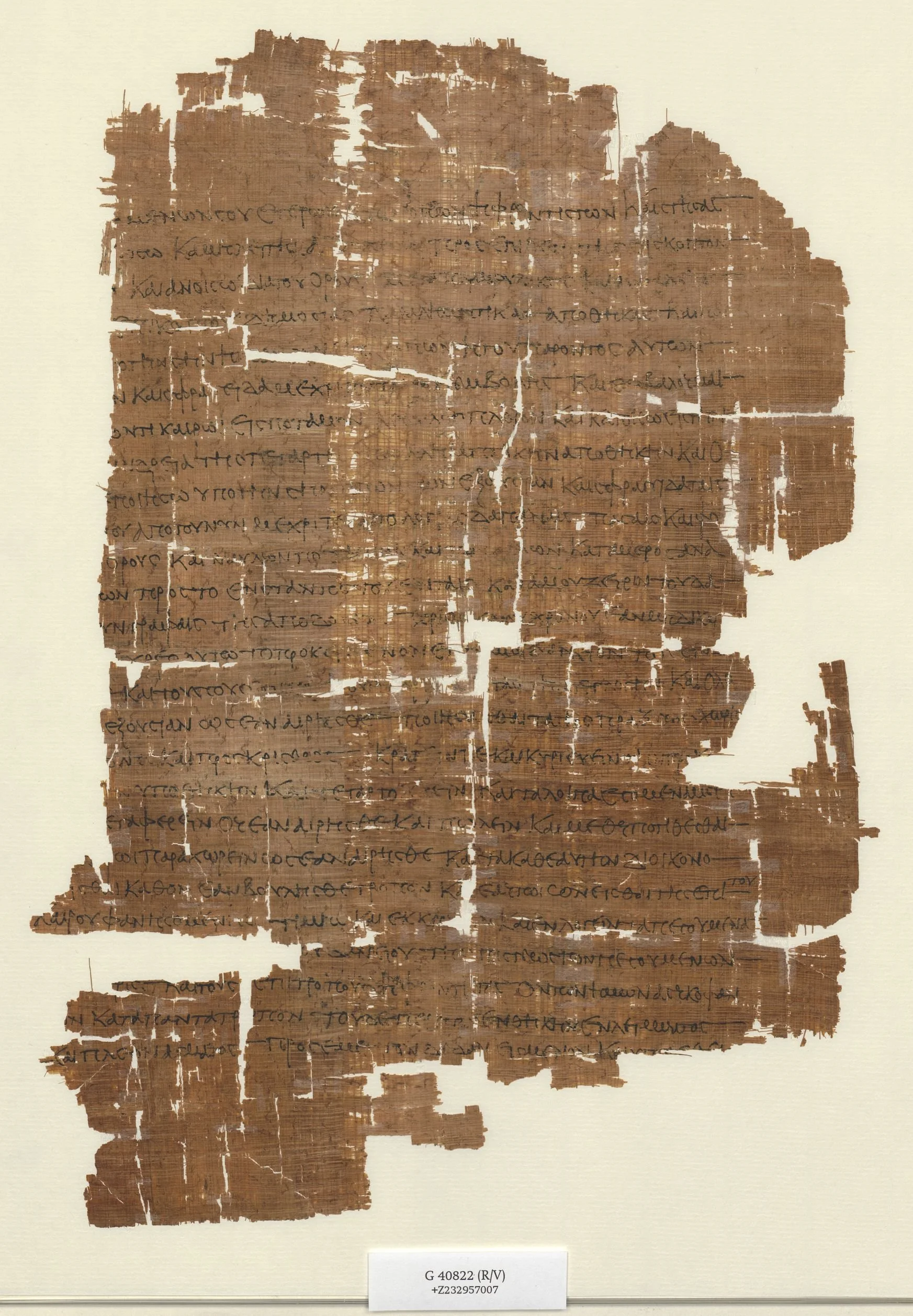
Muziris Papyrus (Papyrus Vindobonensis G 40822), mid-2nd century CE, ink on papyrus, approx. 38 x 25 cm (fragment), Austrian National Library (Österreichische Nationalbibliothek), Vienna. Link.
The Contract: Muziris Papyrus
Brittle, jagged, and scattered with lacunae, the fragility of the Muziris Papyrus serves as a stark contrast to the massive economic weight of its Greek cursive inscription. This papyrus fragment, in particular, spans nineteen centuries and records a commercial loan for a single maritime cargo valued at nearly seven million sesterces, which was enough to purchase a large Italian estate at the time.[5] The ledger-like document also records goods like Gangetic nard, ivory, and textiles in systematic columns of value and corresponding liability.[6] While Roman merchants often used such credit instruments to transform the potential of shipwreck and piracy into calculable risks, investors used these contracts to pool together the immense capital required for pepper-seeking voyages beyond any single merchant’s resources, similar to modern venture capital. In other words, this rigid, precise layout demonstrates that the Indo-Roman pepper trade was a sophisticated industry that relied on complex legal contracts to hedge against potential Indian Ocean risks. The survival of such a document, against all odds, shows that Ancient Rome’s steady flow of pepper was supported by a sophisticated credit system that integrated legal stability with maritime uncertainty.
The Bullion: Slashed Aureus of Emperor Claudius
The defining feature of this gold aureus, likely used during the Indo-Roman pepper trade, is the deep chisel mark that disfigures the side profile of Roman Emperor Nero Claudius Drusus. Although this coin was originally minted in Rome as legal tender with the standard weight and imperial imagery of the first century, the slash proves that its function changed radically once it crossed the Indian Ocean.[7] To clarify, this violent mark was not an act of political vandalism; rather, it served as a calculated economic test known as an assay. Indian merchants, who did not recognize the fiat authority of Roman royalty, used a chisel to cut into the metal and verify that the coin was solid gold rather than a plated forgery.[8] This mark, intentionally penetrating the thickest part of the relief, suggests that Roman and Indian economies relied on the tangible value of bullion, rather than ambiguous political trust. Thus, the slashed aureus reveals the literal price of the pepper trade: Rome was forced to strip away imperial vanity to meet the rigid gold standards of Indian markets, embodying the friction of ancient globalization and speaking to the universal value of taste as an economic engine.
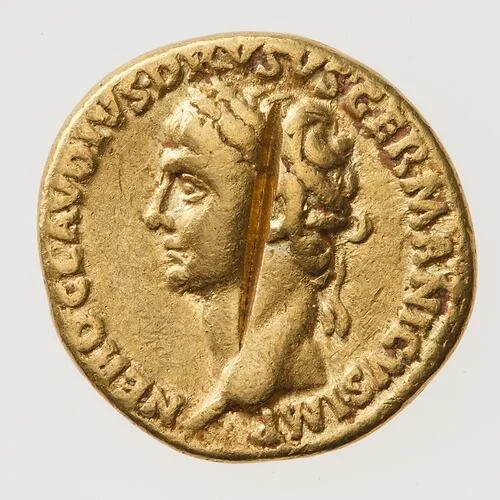
Aureus of Emperor Claudius (Slash-Marked), 41-45 CE, gold, 19 mm diameter, Museums Victoria, Melbourne. Link.
2. Infrastructure, Logistics, & Movement
How do you coordinate a 4000-mile journey for a perishable spice? This logistical feat required a complex intermodal network, where corporate shipping guilds and camel caravans synchronized to beat the monsoon seasons and transition from sea to land to river. From the headquarters of the fleet to the saddles of the desert, the objects below show that the steady flow of pepper relied on a seamless institutional handover between maritime routes and the desert infrastructure.

Mosaic of the Shipping Guilds (Station 21, Naviculari et Negotiantes Karalitani), 190-200 CE, black and white floor mosaic, Piazzale delle Corporazioni, Ostia Antica. Link.
The Corporation: Mosaic of the Shipping Guilds (large print)
Located in the bustling Square of the Corporations in Ostia, the port city of Ancient Rome, the coarse black-and-white tesserae of this floor mosaic functioned as commercial signage. The mosaic’s design features a massive merchant freighter with a square-rigged sail in between two grain measures, which were standardized buckets used to measure dry goods.[9] In addition, the mosaic features a rare, capitalized inscription that reads “The Shipowners and Merchants of Cagliari,” explicitly projecting a link between the financiers and labor transporters of Ancient Rome: a guild.[10] While the presence of the grain measures was intended to serve as a guarantee of commercial precision and advertise the guild’s ability to accurately transport cargo, the hand-cut inscription proves that the infrastructure of Indo-Roman trade was not just physical ships but a corporate partnership between sailors and sellers. Not only was trade managed by organized syndicates that pooled the capital of investors with the technical assets of fleet operators, but more importantly, maritime risk became shared across a collaborative network. Thus, this ancient stone advertisement demonstrates that the infrastructure that enabled the Indo-Roman pepper trade was fundamentally social and relied on the loyalty of merchant coalitions to enable appropriate risk management.
The Connector: Terracotta Transport Camel
Molded by hand from red clay, this terracotta camel provides an image snapshot of the intermodal logistics required to move goods from the Red Sea to the Nile. Notably, a specialized pack saddle is attached to the camel’s back to carry four distinct transport amphorae, which were purely utilitarian, ceramic shipping containers of the Ancient Mediterranean.[11] This specialized saddle was specifically designed to transport the exact standardized containers that were found in the hulls of Roman freighters.[12] In other words, this detail depicts the camel not as any wild animal, but as a calibrated instrument of imperial transport that was engineered to haul fragile loads across the harsh terrain of the Eastern Desert. Ancient trade logistics took the time to integrate tailored containerization so goods could transition from ship to sand without the inefficiency of repacking.[13] In the context of the Indo-Roman pepper trade, containerization suggests that the maritime and terrestrial legs of voyages were preemptively synchronized; the biological endurance of the camel and standardization of the amphora combined to operate as a unified intermodal machine, turning a daunting 100-mile trek into the routine leg of a global supply chain.
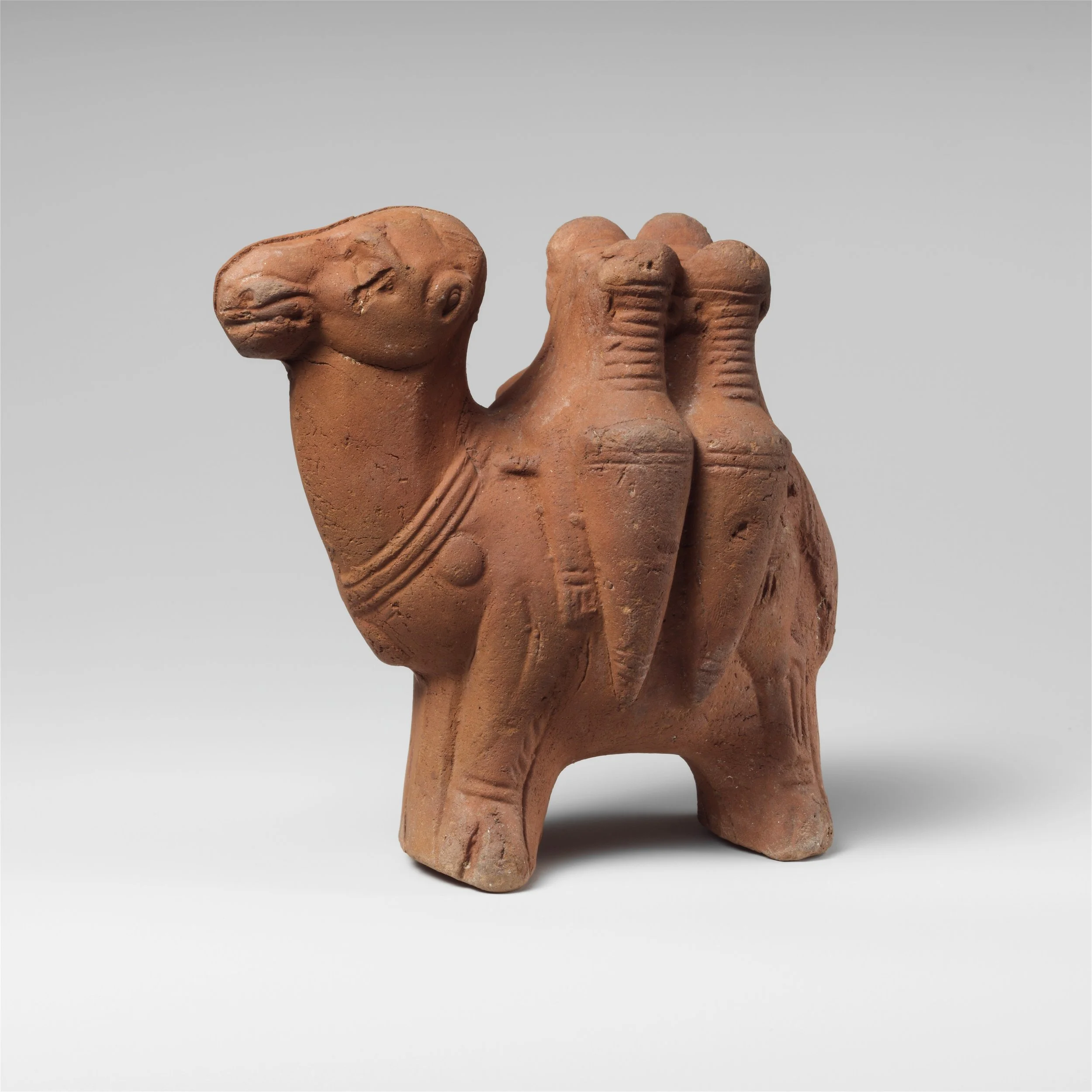
Terracotta Figurine of a Camel Carrying Transport Amphorae, late 2nd-early 3rd century CE, terracotta, 11.8 cm high, The Metropolitan Museum of Art, New York. Link.
3. Regulation, Scale, & Accessibility
How do you transform an exotic harvest into a standardized imperial commodity? Once it reached the Roman Empire, pepper ceased to be a mere agricultural crop and entered a rigorous machine of state bureaucracy. From industrial storage jars to state-calibrated weights, the objects below show that the creation of a global taste was no accident, sustained by a system of standardization that allowed pepper to be bulk-stored, taxed, and valued as reliably as currency.
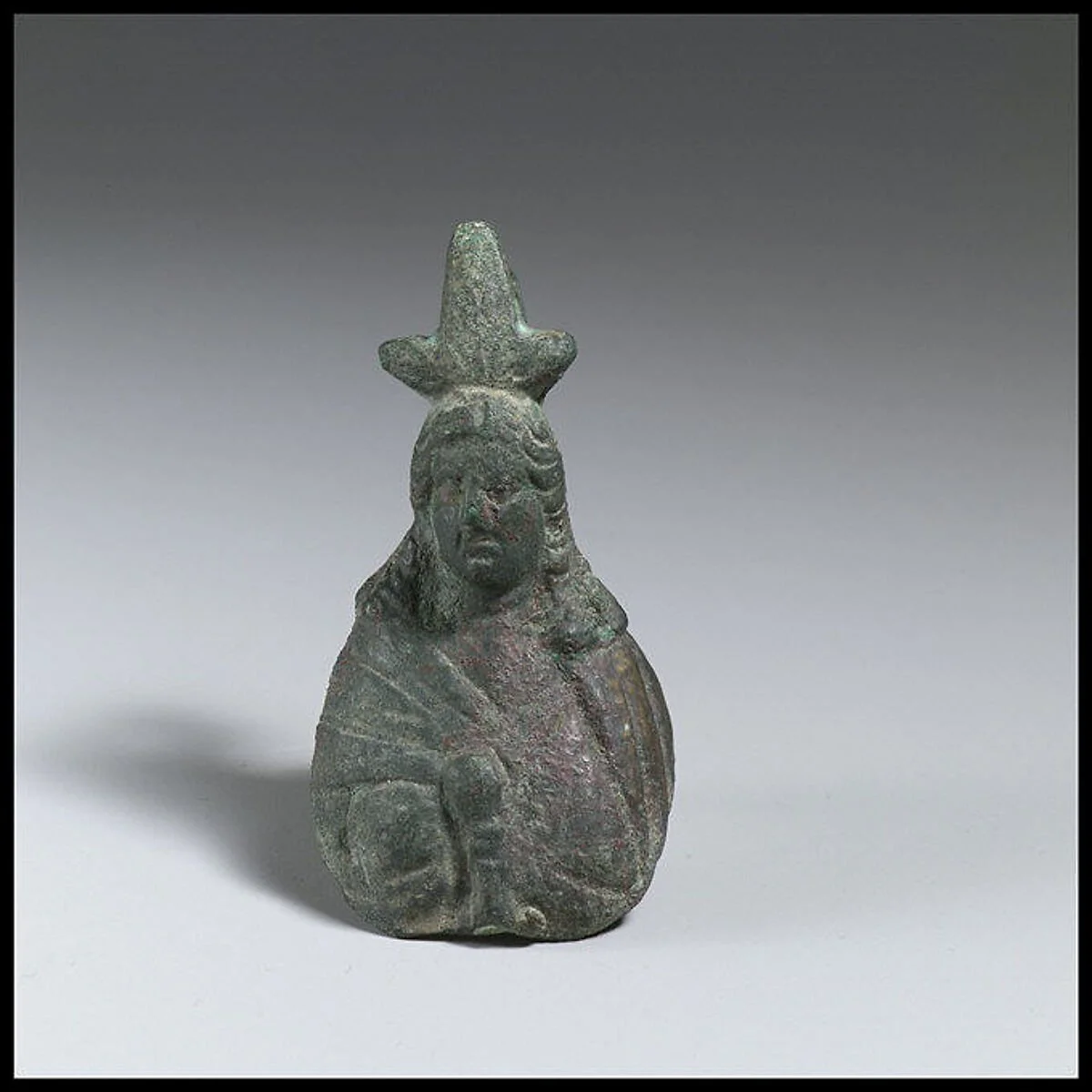
Bronze Steelyard Weight in the Form of a Bust of Isis, 2nd-3rd century CE, bronze, 7.6 cm high, The Metropolitan Museum of Art, New York. Link.
The Standard of Value: Bronze Isis Steelyard Weight
While this bronze bust with the weight of a golf ball displays the aesthetic elegance of a decorative statue, it served a functional purpose. The figure, intended to be suspended from a steelyard balance, functioned as a heavy counterweight used in imperial customs houses.[14] The hook embedded in the head of the figure allowed the counterweight to serve as the trusted standard against which incoming cargoes were measured. Notably, the choice of subject is also intentional; the figure depicts Isis, the patron goddess of the sea and the Pharos lighthouse of Alexandria, to explicitly connect the act of weighing to maritime trade arriving from Egypt.[15] This method of standardization was critical to trading pepper, as spice was treated with the same precision as gold and sold by weight, rather than volume.[16] In other words, a merchant in India, a tax collector in Alexandria, and a buyer in Rome were able to agree on the exact value of the same sack of pepper by using this counterweight. By translating a distant, exotic harvest into a universally recognized value, such counterweights transformed pepper from a mere agricultural product into a stable financial asset that could be taxed and traded.
The Scale: Roman Transport Amphora
As featured in the terracotta camel figure, amphorae are utilitarian, standardized shipping containers built for transporting goods in ancient trade. Upon initial observation, the physical dimensions of this terracotta vessel offer an immediate rebuttal to the myth that pepper was traded solely in small, treasure-like quantities.[17] Standing at nearly a meter tall, the vessel features a spiked base, thick, reinforced walls, and a narrow, sealable neck built to sustain the rough handling inherent to a ship’s hull during stormy nights.[18] The vessel’s curved form also allowed for interlocking layers to maximize stability during monsoon seasons. Furthermore, archaeological excavations at the Red Sea port of Berenike have similar amphorae containing up to 7.5 kilograms of black peppercorns, proving that Roman merchants were not trading in pinches of spice but in industrial volumes, comparable to grain or olive oil, that necessitated this type of standardized, heavy-duty containerization.[19] By packaging Indian harvests into mission-oriented vessels of durability, Roman merchants scaled the pepper trade from a trickle of luxury to mass-market consumption, leading to a fundamental transformation of the Roman empire’s dietary habits.
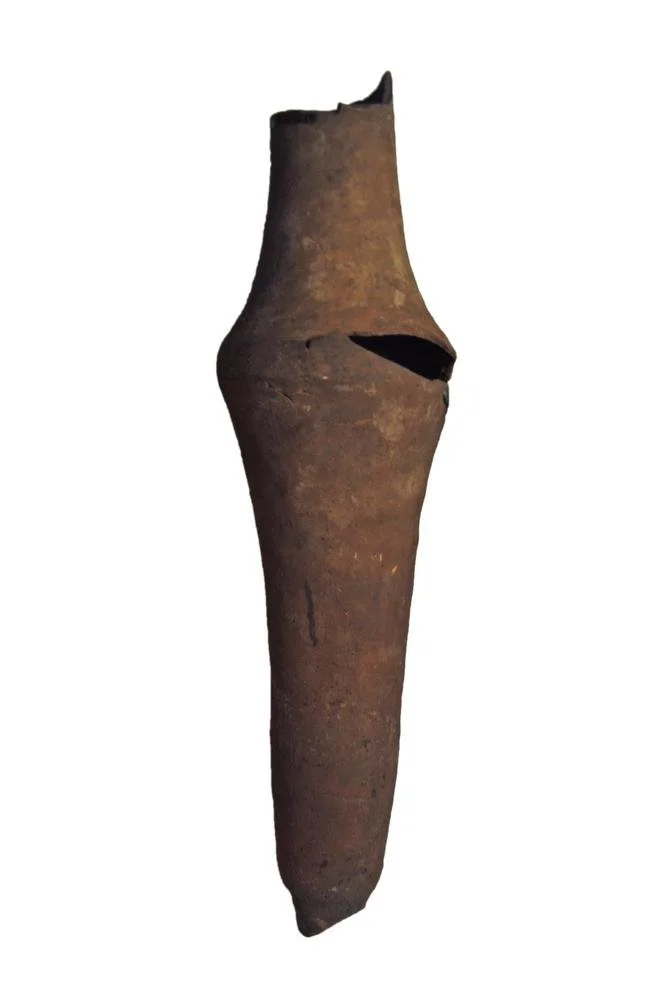
Transport Amphora (Type AE3), 30 BC-230 CE, pottery, 70 cm high, The British Museum, London. Link.
4. Consumption
How does a distant spice become a cultural necessity? The ultimate success of pepper’s global network was the seamless integration of an Indian berry into the Roman identity. From practical cookbook recipes to the silver centerpieces of the elite table, the objects below demonstrate that pepper transcended its origins from the 4th to the 9th century CE, becoming both a daily staple and a symbol of Rome’s ability to consume the world.
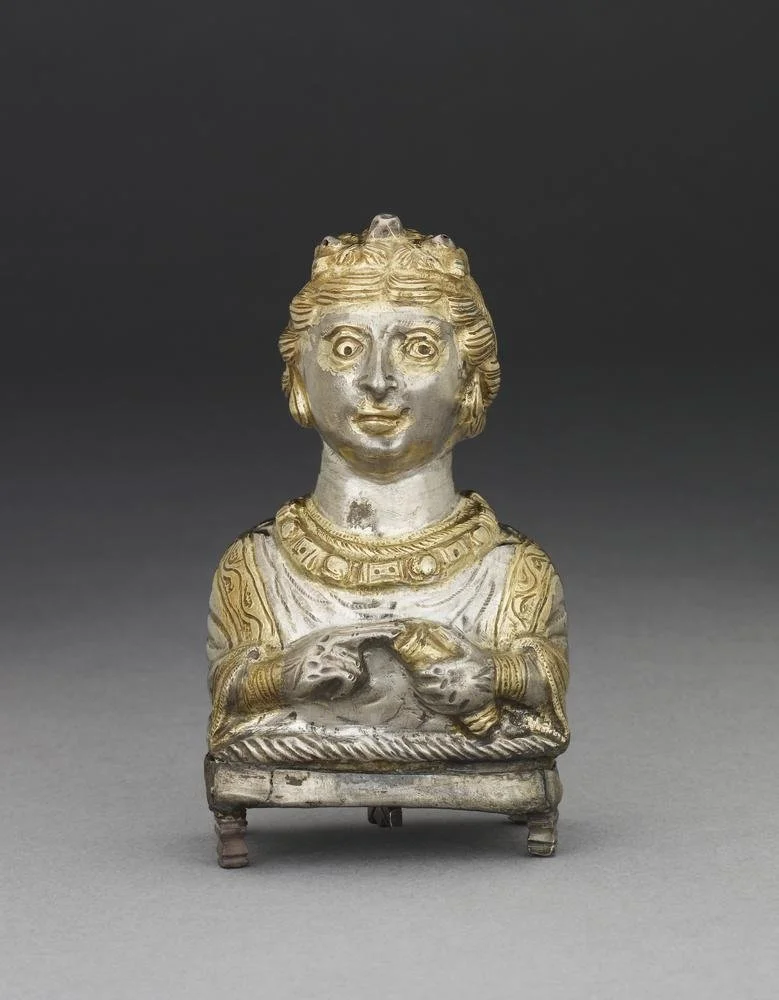
Hoxne "Empress" Pepper Pot, 300-400 CE, silver and gold, 10.3 cm high, The British Museum, London. Link.
The Centerpiece of Status: Hoxne Empress Pepper Pot
This functional, silver vessel takes the form of a rich Roman matron with gilded details on her jewelry, robe, and scroll, reflecting the social significance of its contents during the 3rd and 4th century CE. While pepper was already somewhat of a commodity by then, having first been imported from India to Rome in the first century AD, piperatoria, special containers for shaking pepper, remained exceedingly rare and reserved for the elite.[20] This particular vessel features a hollow silver statuette of a woman’s body, embellished with various symbols of status, as well as a rotating base that allows the user to select between three settings: closed, wide pouring (for filling), or fine sprinkling.[21] This mechanical precision suggests that seasoning food was not merely a cultural act but a performative ritual at elite dinner tables, designed for the purpose of enjoyment. Simultaneously adorned with striking visual features and functional ingenuity, the twofold specialization of this pepper pot represents the elevation of a simple condiment into a symbol of imperial identity. This luxury centerpiece is physical proof of the Indo-Roman pepper trade’s ability to integrate foreign commodities into artisanal, social assets and the permanent fabric of broader cultural life.
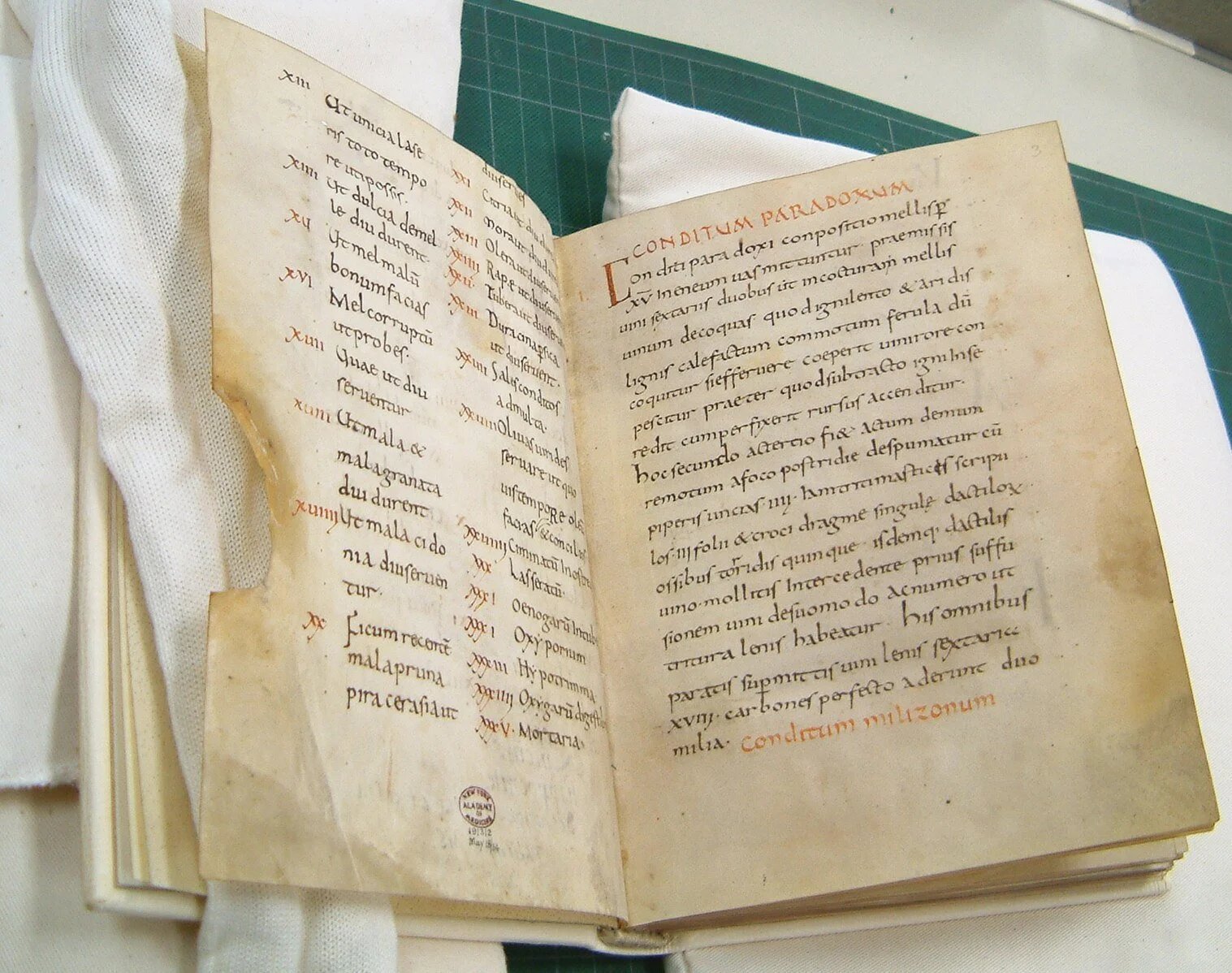
Apicius: De re culinaria (Manuscript), 9th century CE (based on 4th-5th century CE text), ink on parchment, 23.1 x 18 cm, New York Academy of Medicine, New York. Link.
The Integration of Taste: Apicius Cookbook
This particular manuscript was transcribed in a Carolingian monastery in the 9th century and preserves the culinary recipes of the late Roman Empire.[22] The Apicius, translated to “On the Subject of Cooking,” offers statistical proof of pepper’s integration into the ancient Roman diet; out of the nearly 500 recipes in the cookbook, roughly 400 call for the use of pepper.[23] More importantly, however, the ingredient appears indiscriminately; pepper is used to flavor everything, from ostrich stews and roasted boar to vegetable sides and even desserts.[24] In other words, the near unconditional frequency with which the Apicius instructs the cook to pound pepper implies that by the late Roman Empire, pepper was cemented as a pantry stable, similar to garum and olive oil, rather than a rare exotic delicacy.[25] This surprising textual ubiquity suggests that the Indo-Roman pepper trade not only transformed a distant Indian harvest into a cultural necessity but also reached the ultimate success of any trade network: the creation of a permanent, mass-market demand. In this sense, the most enduring legacy of the Roman Empire was its ability to colonize the senses, embedding the taste of India into ambitions of daily sensory enrichment.
Footnotes
[1] Federico De Romanis, The Indo-Roman Pepper Trade and the Muziris Papyrus (Oxford: Oxford University Press, 2020), 29.
[2] Raoul McLaughlin, The Roman Empire and the Indian Ocean: The Ancient World Economy and the Kingdoms of Africa, Arabia and India (Barnsley: Pen & Sword Military, 2014), 125.
[3] Joseph Dommers Vehling, Apicius: Cookery and Dining in Imperial Rome (Chicago: Walter M. Hill, 1936), 20.
[4] "Hoxne Hoard Pepper Pot," The British Museum, accessed December 14, 2025, https://www.britishmuseum.org/collection/object/H_1994-0408-33.
[5] De Romanis, 29.
[6] De Romanis, 85.
[7] Jeremy A. Simmons, "Behind Gold for Pepper: The Players and the Game of Indo-Mediterranean Trade," Journal of Global History 18, no. 3 (2023): 355.
[8] McLaughlin, 126.
[9] Roberta Tomber, Indo-Roman Trade: From Pots to Pepper (London: Duckworth, 2008), 70.
[10] Tomber, 71.
[11] "Terracotta Figurine of a Camel Carrying Transport Amphorae," The Metropolitan Museum of Art, accessed December 14, 2025, https://www.metmuseum.org/art/collection/search/245523.
[12] Tomber, 76.
[13] Tomber, 77.
[14] "Bronze Steelyard Weight in the Form of a Bust of Isis," The Metropolitan Museum of Art, accessed December 14, 2025, https://www.metmuseum.org/art/collection/search/256823.
[15] “Bronze Steelyard Weight in the Form of a Bust of Isis.”
[16] Pliny the Elder, Natural History, trans. H. Rackham (Cambridge: Harvard University Press, 1945), 12.14.
[17] Tomber, 75.
[18] Tomber, 76.
[19] Tomber, 78.
[20] "Hoxne Hoard Pepper Pot," The British Museum.
[21] "Hoxne Hoard Pepper Pot."
[22] Tomber, 127.
[23] "Apicius [De re culinaria Libri I-IX]," New York Academy of Medicine, accessed December 14, 2025, https://digitalcollections.nyam.org/islandora/object/islandora%3A1116.
[24] Vehling, Apicius, 18.
[25] Vehling, 19.
Works Cited
"Apicius [De re culinaria Libri I-IX]." New York Academy of Medicine. Accessed December 14, 2025. https://digitalcollections.nyam.org/islandora/object/islandora%3A1116.
Bowman, Alan K., and Andrew Wilson, eds. Quantifying the Roman Economy: Methods and Problems. Oxford: Oxford University Press, 2009.
"Bronze Steelyard Weight in the Form of a Bust of Isis." The Metropolitan Museum of Art. Accessed December 14, 2025. https://www.metmuseum.org/art/collection/search/256823.
Cappers, René T. J. Roman Foodprints at Berenike: Archaeobotanical Evidence of Subsistence and Trade in the Eastern Desert of Egypt. Los Angeles: Cotsen Institute of Archaeology, 2006.
Casson, Lionel. The Ancient Mariners: Seafarers and Sea Fighters of the Mediterranean in Ancient Times. Princeton: Princeton University Press, 1991.
Cobb, Matthew Adam. Rome and the Indian Ocean Trade from Augustus to the Early Third Century CE. Leiden: Brill, 2018.
De Romanis, Federico. The Indo-Roman Pepper Trade and the Muziris Papyrus. Oxford: Oxford University Press, 2020.
"Hoxne Hoard Pepper Pot." The British Museum. Accessed December 14, 2025. https://www.britishmuseum.org/collection/object/H_1994-0408-33.
"Marble Relief Showing Transport Amphorae." The Metropolitan Museum of Art. Accessed November 21, 2025. https://www.metmuseum.org/art/collection/search/251843.
Mayer, Ernst Emanuel. "'Tanti Non Emo, Sexte, Piper': Pepper Prices, Roman Consumer Culture, and the Bulk of Indo-Roman Trade." Journal of the Economic and Social History of the Orient 61, no. 4 (2018): 560–589.
McLaughlin, Raoul. The Roman Empire and the Indian Ocean: The Ancient World Economy and the Kingdoms of Africa, Arabia and India. Barnsley: Pen & Sword Military, 2014.
"Muziris Papyrus (Papyrus Vindobonensis G 40822)." Austrian National Library. Accessed November 21, 2025. https://viewer.onb.ac.at/10053CAD.
Perry, Julian. "What the Roman Empire Got from India: Pepper." BrandeisNOW, May 15, 2019. https://www.brandeis.edu/now/2019/may/pepper-rome-ancient.html.
Pliny the Elder. Natural History. Translated by H. Rackham. Cambridge: Harvard University Press, 1945.
Sidebotham, Steven E. Berenike and the Ancient Maritime Spice Route. Berkeley: University of California Press, 2011.
Simmons, Jeremy A. "Behind Gold for Pepper: The Players and the Game of Indo-Mediterranean Trade." Journal of Global History 18, no. 3 (2023): 343–364.
Terpstra, Taco. Trade in the Ancient Mediterranean: Private Order and Public Institutions. Princeton: Princeton University Press, 2019.
"Terracotta Figurine of a Camel Carrying Transport Amphorae." The Metropolitan Museum of Art. Accessed December 14, 2025. https://www.metmuseum.org/art/collection/search/245523.
Tomber, Roberta. Indo-Roman Trade: From Pots to Pepper. London: Duckworth, 2008.
Van der Veen, Marijke, and Jacob Morales. "The Roman and Islamic Spice Trade: New Archaeological Evidence." Journal of Ethnopharmacology 167 (2015): 54–63. https://doi.org/10.1016/j.jep.2014.09.036.
Vehling, Joseph Dommers. Apicius: Cookery and Dining in Imperial Rome. Chicago: Walter M. Hill, 1936.